
Some of the most frequently asked marketing questions I hear from business leaders are “what should I spend on marketing this year?” or “How do I make an annual marketing budget?” or “How do I know if I’m investing in the right things?” In fact, nearly 60% of marketers say how they spend their marketing budget is being scrutinized now more than in the past (source).
Of course, there are many factors that influence budgets. And once the topline budget number is set, even more considerations come into play with allocating the budget amongst competing needs in the marketing space.
If you’re looking for overall guidance on planning your marketing year, be sure to check out my companion blog, Mastering Marketing: An Expert’s Guide at Crushing Your Annual Goals. If you’re ready to dig deeper into budgeting specifically, let’s take a look at typical setups across industries to see where your company may fall.
Average Annual Marketing Budgets by Industry & Company Type
In 2023, the typical marketing budget was just over 9% of company revenue (source). But we all know that a typical average isn’t always applicable to every business or situation.
My initial recommendation for how to make your annual marketing budget starts at a high level. Consider your business type – do you have a business-to-business or business-to-consumer model; do you sell products or services; what industry are you in?
B2C companies tend to allocate more to marketing than B2B companies, and service-based businesses typically spend more than product-based businesses (source). Marketing budget allocation also tends to vary widely across industries; consumer packaged goods (CPG) brands spend more on average than finance and healthcare when considering marketing budgets as a percentage of annual company revenue.
On that note, company revenue may be one of the most important factors to consider. With respect to the factors mentioned above, a company making $15MM annually will likely have a higher marketing budget than a $5MM company with similar offerings in the same industry.
One of my favorite tools is this Hubspot blog breaking down this exact thing: marketing budgets by industry as a percentage of company revenue. These insights are informed by their own State of Marketing report as well as Statista’s CMO survey—and it’s updated annually.
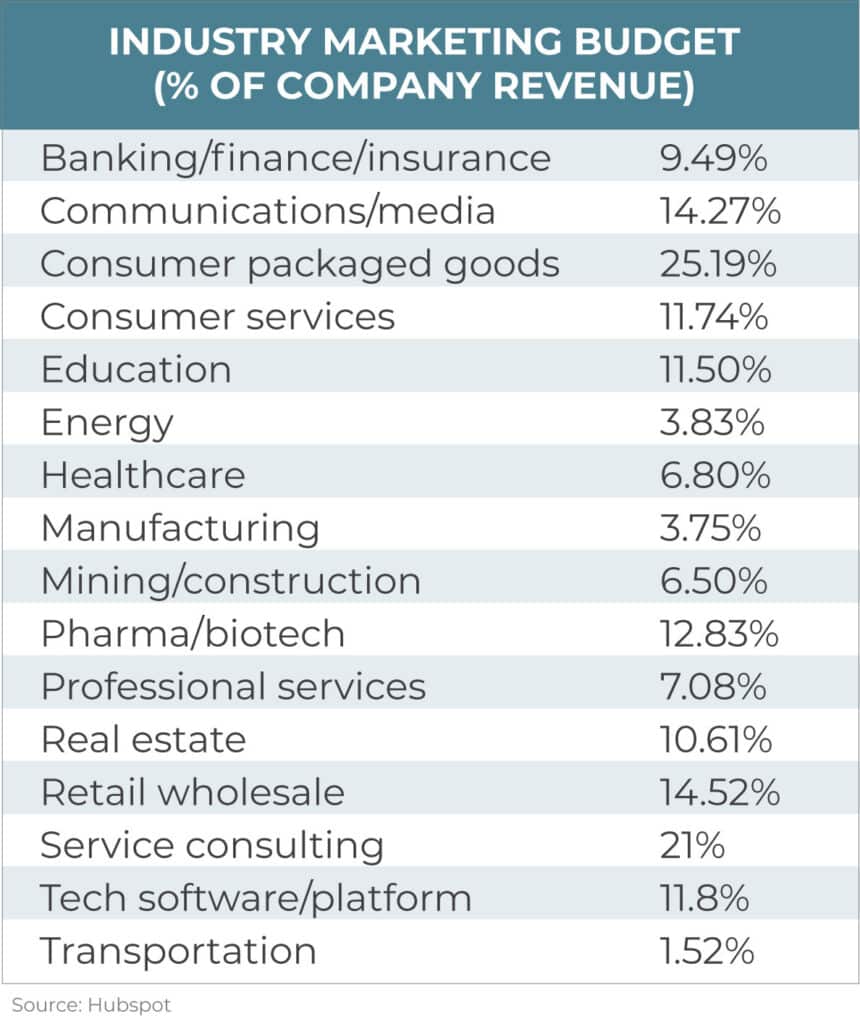
While these are averages and individual company budgets can vary widely from these benchmarks, it’s a good place to start. It’s also well-informed research that can serve as a helpful tool to make your case to company leadership and the CFO.
Factors that May Influence Your Marketing Budget
Once you have an idea of what the average budget looks like for a company of your type, size and industry, the next step is to consider what phase your business is in, as well as looking at your competitive landscape.
Oftentimes I see people do this backwards: set a firm budget number, then consider factors to allocate within that. However, there are many times that these factors should be considered before that hard budget number is arbitrarily locked in.
- Is your company new or in ‘growth’ mode?
- Are you planning to launch new products or services?
- Are you seeking to attract new customers or branch out into a whole new market?
- Is your business landscape growing more competitive?
- Are there any bigger investments you need to plan for this year like rebranding, a new website, etc.?
If you answered yes to any of the above, you should outline those needs/goals and estimate the financial investment needed to address those factors.
Finally, the best marketing budgets contain a heavy dose of reality. There are real-world factors that will undoubtedly affect your budgeting exercise.
- Threshold of spend: how has your budget looked in the past? It’s more likely that you’ll grow your budget incrementally over time, so don’t expect to go from zero to 100 overnight. Does the owner, president or C-level team of the company value marketing? If so, they’re more likely to approve budget increases for justifiable reasons; if not, you may have some work to do to prove value and influence your decision-makers.
- Return on investment: depending on your business and marketing goals, it’s likely that the company will expect to see healthy ROI for at least a portion of your marketing efforts. Reference past use cases to show how marketing investments positively impact the business’s bottom line, and outline expected ROI for future efforts to justify the costs.
- Inflation: as with everything in life, marketing budgets must take inflation into account. If your marketing budget is flat for years on end, that’s effectively a decrease when you consider the naturally rising costs of advertising placements, agency support, software and tools, etc.
Prioritizing Your Budget in Relation to Goals
Once your initial budget is set at a high level, the next step is to drill deeper into specific goals, strategies, initiatives and priorities. This exercise helps allocate your overall budget into smaller chunks, ensuring money is spent on the right things to make the biggest impact on your business.
This step is where budgeting meets planning. As a marketing leader within your organization, ideally, you’ll have insight into overall company goals. From there, you should outline marketing goals and objectives that will contribute in a meaningful way to reaching the company goals. Once your marketing objectives and goals are established, you can outline strategies to reach each goal.
For example, if the company hopes to grow overall market share and increase revenue by 10% next year, your marketing goals and strategies would likely focus on growing brand awareness, generating new customer leads, and increasing conversions and customer lifetime value. Strategies might include running brand awareness and lead generation campaigns, optimizing conversion rates across your customer journey, cross-selling or up-selling to current customers, etc.
Related to my earlier point about ROI, you should also set key performance indicators (KPIs) for each recommended strategy so you’ll know how to measure success. In some cases, it might be a hard number that measures return on investment, i.e. revenue; in other cases, it might be different marketing measurables like impressions, conversion rates, or something else. You’ll thank yourself later for setting these KPIs up front and tracking throughout the year; it’s a great tool to use for budgeting and planning so you’ll know what drove the biggest impact to influence future investments and marketing plans.
Another handy tool is the 70/20/10 rule. 70% of your marketing budget goes to proven strategies, 20% goes to new strategies, and 10% goes to experimental strategies. Always leave room to experiment and test new things!
Key Takeaways
Budgeting, like most things in life, isn’t linear. To set an effective annual budget (and plan) for marketing, you need to consider the big picture and the smaller details, then leave room for flexibility and iteration.
- Consider budgeting standards of your industry, business type and size
- Think about what your company–and marketing department–want to achieve, and earmark funding to support those efforts
- Align with internal leadership and decision makers on your ‘big picture budget’
- Drill down into the specifics of your plan to allocate budget to various items and priorities accordingly
- Set KPIs and measure ROI whenever possible; use these data points to justify your investments, request additional budget when needed, and influence future plans and decisions
Have specific questions about setting your budget or creating marketing plans? We’d love to continue the conversation! Reach out to Bria directly via email or connect with us on Facebook or LinkedIn.
Reach out today, and let’s chat!