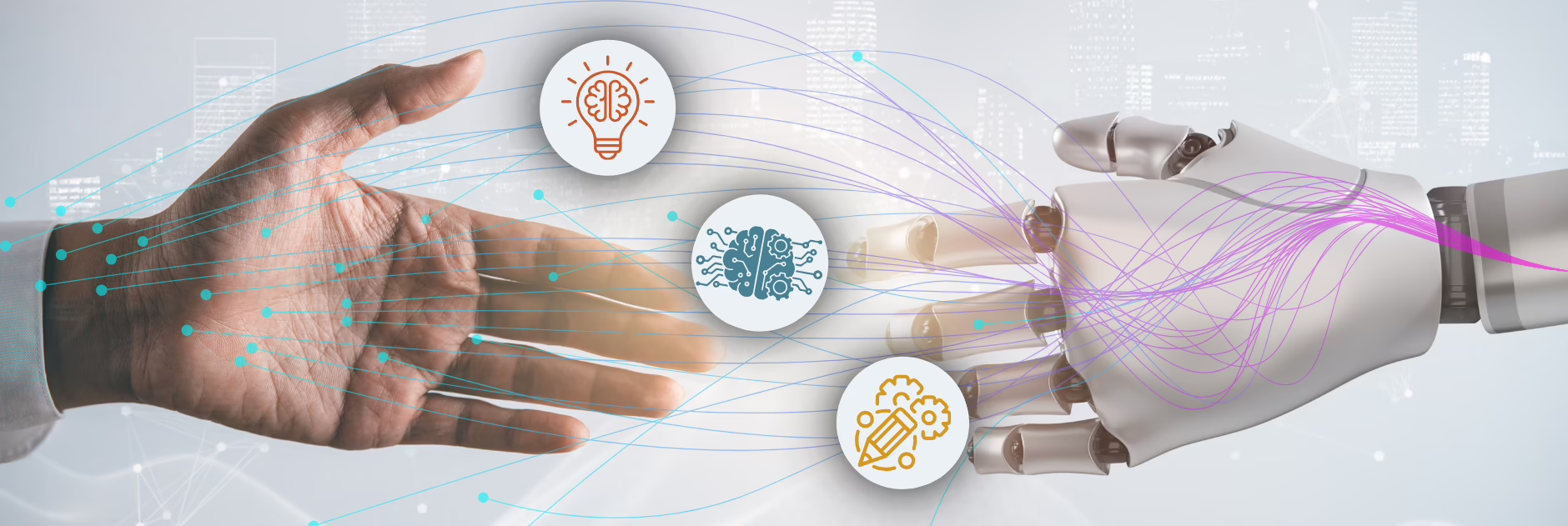
Well, friends. After years of warnings from sci-fi movies, the robots have finally entered the chat. And apparently, they brought instant illustrations, coding skills and copy decks with them.
Just scroll LinkedIn for five minutes, and you’ll see that everyone is a designer now. Everyone is a writer. Everyone is a strategist. With just a few prompts (and a polite “please” thrown in for good measure), AI chatbots will generate anything from logos and moodboards to ad headlines, audience breakdowns and posting strategies all before your client’s coffee cools.
This environment raises a lot of questions. Ones you’ve probably been afraid to ask, because let’s be honest, this is scary territory for people like us. But we’re going to ask them anyway.
If everyone can create now, what makes the creative work we do valuable? What are the downsides to handing over this much of our reigns to a machine? Are there any sacred spaces left within our industries? Spaces where the heavy lifting is best left to the ones who actually do the feeling and reasoning and connecting with fellow humans?
The Great Zombification of Doing
AI tools have dramatically lowered the barrier to entry for design and writing. Need a landing page headline? Done. A social media series? Easy. Voice-over for video? Just pick an accent. A brand mood board? Give it 30 seconds.
You have the seed of an idea, but you can’t be bothered to learn or acquire the skills to create it? Good news! There’s an AI tool for that now. Who needs continuing education courses or expensive degrees or wasted weekends of trial and error when you can pay a subscription fee forever to make what you want, when you want?
But therein lies the trap. When tools make execution easy, they also make expertise seem unnecessary.
Sure, AI can produce a logo. That doesn’t mean it understands brand architecture, competitive positioning or long-term scalability. It can draft a blog post, but that doesn’t mean it understands voice, nuance, legal risk or audience psychology.
Relying on it too heavily can make you forget that AI isn’t infallible, either. It can hallucinate facts, fabricate data or even accidentally reinforce bias that’s hidden in its training data. After only a few prompts, you’ll probably realize, too, that it has a tendency to default to generic phrasing, flattening all originality into a gobbly-gook of algorithm-friendly sameness.
One of the biggest downsides of this is not just lackluster products, but literally our diminishing ability to create. And when everyone uses similar tools trained on similar content, your work begins to feel indistinguishable from the noise of everything else.
Does AI have a place in the creative process?
As “doomsday-is-neigh” as this blog might sound so far, I do still believe AI has a future in the work we do. Used as a creative amplifier, the accessibility it offers is powerful. It accelerates brainstorming and iteration. It surfaces patterns people may overlook. It helps non-creatives visualize ideas. It unblocks blank pages and turns rough concepts into something tangible quickly. But how it evolves from here is up to us.
Given its natural advantages for synthesizing information and executing repetitive tasks, AI lends itself best as a collaborator, not a creative replacement.
I like to think of it as a high-speed intern. One with endless stamina, no ego and unmatched ability to learn and relearn. It can help you move faster, tackle low-stakes production tasks and generate ideas, but it still needs constant direction, review and discernment.
Of course, no prompt can replace lived experience, emotional intelligence or industry expertise. That’s why it’s important to know when and where AI tools best serve our final products.
Use AI for:
Discovery & Research. Leverage AI to quickly surface trends, summarize large datasets and scan competitor activity. It’s a powerful tool for gathering inputs, not drawing conclusions.
Ideation & Brainstorming. Use AI to generate volume, explore angles and spark unexpected directions. Treat it as a catalyst for ideas, not the source of your final concept.
Production Testing & Scaling. AI excels at drafting variations, resizing assets, formatting content and supporting A/B testing. It speeds execution while humans maintain oversight and quality control.
Let humans lead:
Strategic Decision Making. AI can present options, but humans must define direction. Strategy requires context, judgment and long-term vision that tools cannot replicate.
Messaging Hierarchy Finalization. Determining what to say first, what to emphasize and what to omit demands brand intuition and audience understanding. That prioritization belongs to people.
Addressing Sensitive Topics. Nuanced, high-stakes communication calls for empathy, ethical awareness and lived experience. Human discernment is essential.
Making Claims that Require Data Support. AI outputs must always be verified. Any claim tied to performance, compliance or public trust should be validated and approved by subject matter experts.
Final Visual Renders. While AI can assist in concepting and drafting, final visual assets should be refined and approved by experienced designers to ensure originality, alignment and brand integrity.
AI-Proof Your Process
The environment we now find ourselves in is less “humans versus machines” and more “humans who know how to think versus humans who only know how to prompt.” To truly practice the responsible use of AI in creative development, teams need guardrails that protect both thinking and output.
And that starts with your process:
Strategy first. Tools second. If you prompt before you position, you risk generating content without any direction at all. Define your audience, objective and message hierarchy first. AI should support a strategy that already exists, not invent one on your behalf.
Use AI for exploration, not final answers. Treat outputs as drafts, thought starters or pattern recognition tools. The first response is rarely the best one, anyway.
Fact-check everything. As mentioned above, AI systems are notorious for fabricating statistics and presenting outdated information with total confidence. Building verification into your workflow will help you avoid any awkward “how did that stat get in there” chats with the client.
Own the creation of your brand’s voice. AI tends to default to neutral, generalized language. That may be clean, but it is rarely distinctive. Human creativity is where tone, personality and point of view are sharpened into something ownable.
Preserve space for deep, offline thinking. Not every solution should be generated in a chat window. Some of the strongest ideas surface during loud, messy whiteboard sessions, client conversations or even alone time at the coffee shop.
The Real Creative Advantage
If everyone can generate content, then the true differentiators become discernment, nuance and taste. This means that the brands that win will not be the ones using AI the most. In fact, the ones using it the most might actually fall to the wayside. No, the winners will be the ones using it most intentionally.
Because even though AI can do many things alarmingly well, there are some things that are irreplaceable. It can produce words, but it can’t own a point of view. It can create visuals, but it can’t understand cultural zeitgeist. It can predict patterns, but it doesn’t follow a moral compass.
So, for us, opportunity lies not in resisting AI, but mastering it without surrendering what makes our human creativity so powerful. Because in a world where everyone can make anything, real value lies in knowing what’s worth making in the first place.