
If you’re anything like me, reading one more article about how AI is “reshaping the marketing landscape” is likely the last thing on your to-do list — right below cleaning out your inbox, surely. For years now, marketers have been inundated with think pieces about AI marketing tools, AI-generated creativity and AI doing just about everything short of brewing the office coffee. And, to be fair, there is some truth in the hype.
Industry leaders like HubSpot report that 80% of marketers are using AI for content marketing in 2026. But here’s where the conversation usually skips a step. Simply using AI isn’t the same as using it well. AI can absolutely make small marketing teams faster and more productive, but only when it’s treated less like a magic button and more like a teammate that needs a proper brief.
Why Does Everyone Sound the Same?
If you’ve been anywhere near a Substack “think piece” or a LinkedIn newsfeed lately, you’ve likely picked up on a trend: everything is starting to sound the same. Blogs, social posts, email campaigns—they all sound like the copy-paste regurgitation of the last five pieces of content you read.
Welcome to the age of AI Slop.
AI’s ability to crank out content at a speed humans can only envy raises a slightly uncomfortable question: Is any of it actually worth making? More often than people care to admit, the answer is no. At its core, AI is designed to curate answers from existing information, making most of its output bland, safe and painfully generic. You’re not going to get a groundbreaking idea or a genuinely fresh perspective from a one-shot prompt.
So why does it all start to sound the same? Think of it like baking a cake. Most teams are grabbing the boxed mix, tossing it in the oven and calling it a day. That’s your zero-context, one-line prompt. Technically, yes, it’s a cake. But it tastes like every other cake that came out of the same box—no personality and nothing worth remembering.
To get the best results, you have to bring your own ingredients into the mix. By adding flavors and layering in secret ingredients, you can make the output actually reflect your brand. In AI terms, that’s context, better prompts and the ability to refine. Without that, everything you produce will have a layer of sameness. And it doesn’t just stop at content. It seeps into marketing strategies, campaign ideas, presentations and everything in between.
Feed Brand Context into AI Tools
If, at its base, AI is a generic boxed cake mix, then context is all the spices, mix-ins and toppings you add to make it actually taste good. Without those, you’re serving nothing but dry, crumbling sheet cakes every time.
This is where things tend to go wrong. Unaware marketers will open the AI tool, type something like “write a social media post about our services,” and expect a Michelin-star response. In reality, AI can only work with what you give it. AI tools become dramatically more useful for marketers when they are trained with brand context through structured prompting and iterative refinement. If the AI prompt contains zero brand context, zero strategic direction and zero understanding of your audience, the output will reflect exactly that.
Training AI Tools on Your Brand
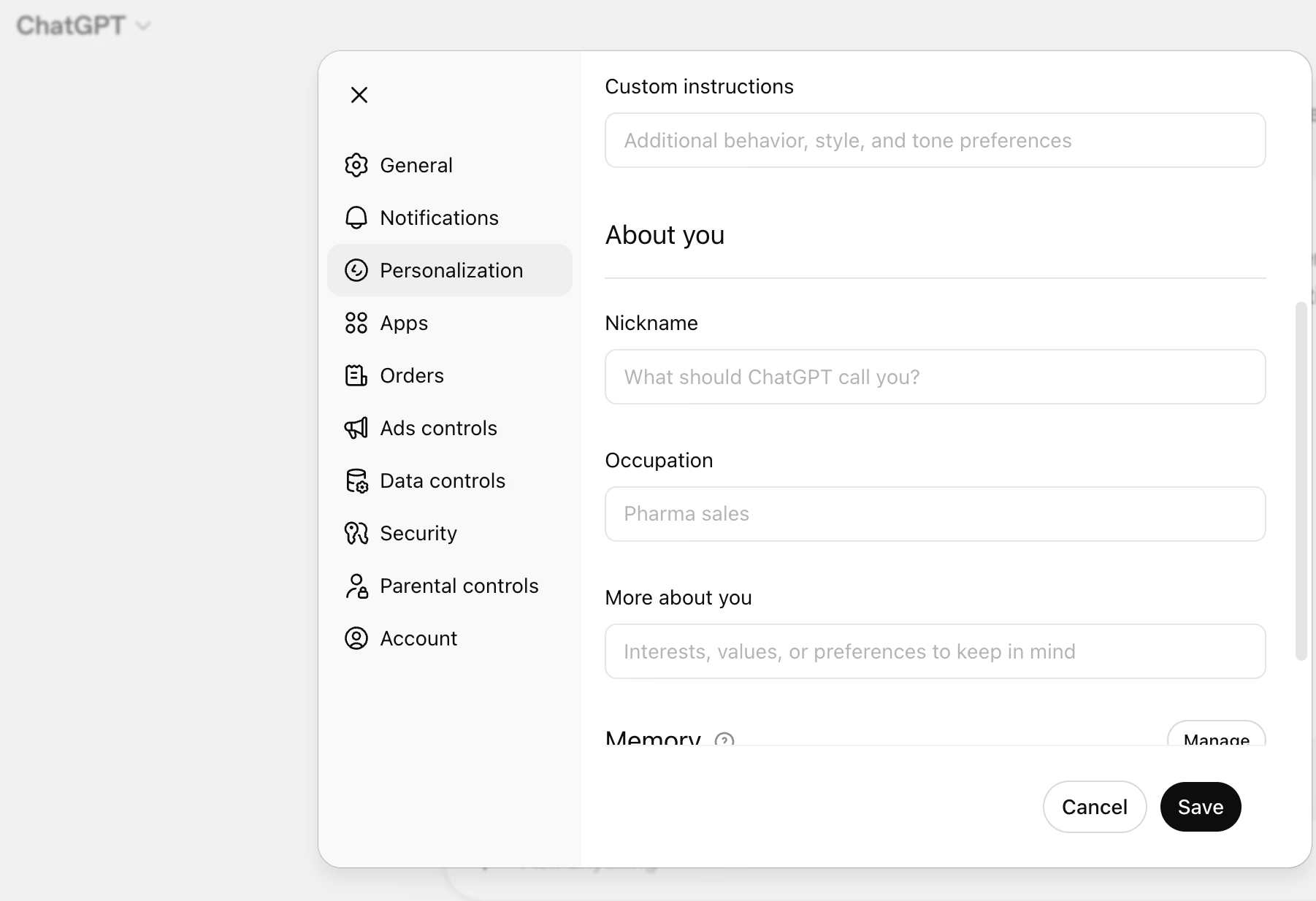
A quick way to get started is to check out the personalization settings in AI marketing tools like ChatGPT. These allow you to set default instructions that apply across conversations: who your company is, who you serve and how you communicate. Over time, the tool begins to behave less like a random content generator and more like a team member who’s spent some time learning your brand.
Another helpful approach is giving AI access to the documents that already define your marketing strategy. Tools like Google NotebookLM allow you to upload brand guidelines, research reports and campaign briefs. Rather than relying solely on what it learned from the broader internet, the AI can reference your internal materials when generating ideas or answering questions.
You can also use tools like Jasper, which are specifically designed for branded content generation. Within the platform, you can define brand voice, tone, style preferences and product messaging upfront. It then uses that information to generate content that is better aligned with your brand. This reduces the need to re-explain your brand and helps maintain consistency across outputs—like hiring a junior team member and training them on your brand, rather than outsourcing to a contractor and hoping they do the right things.
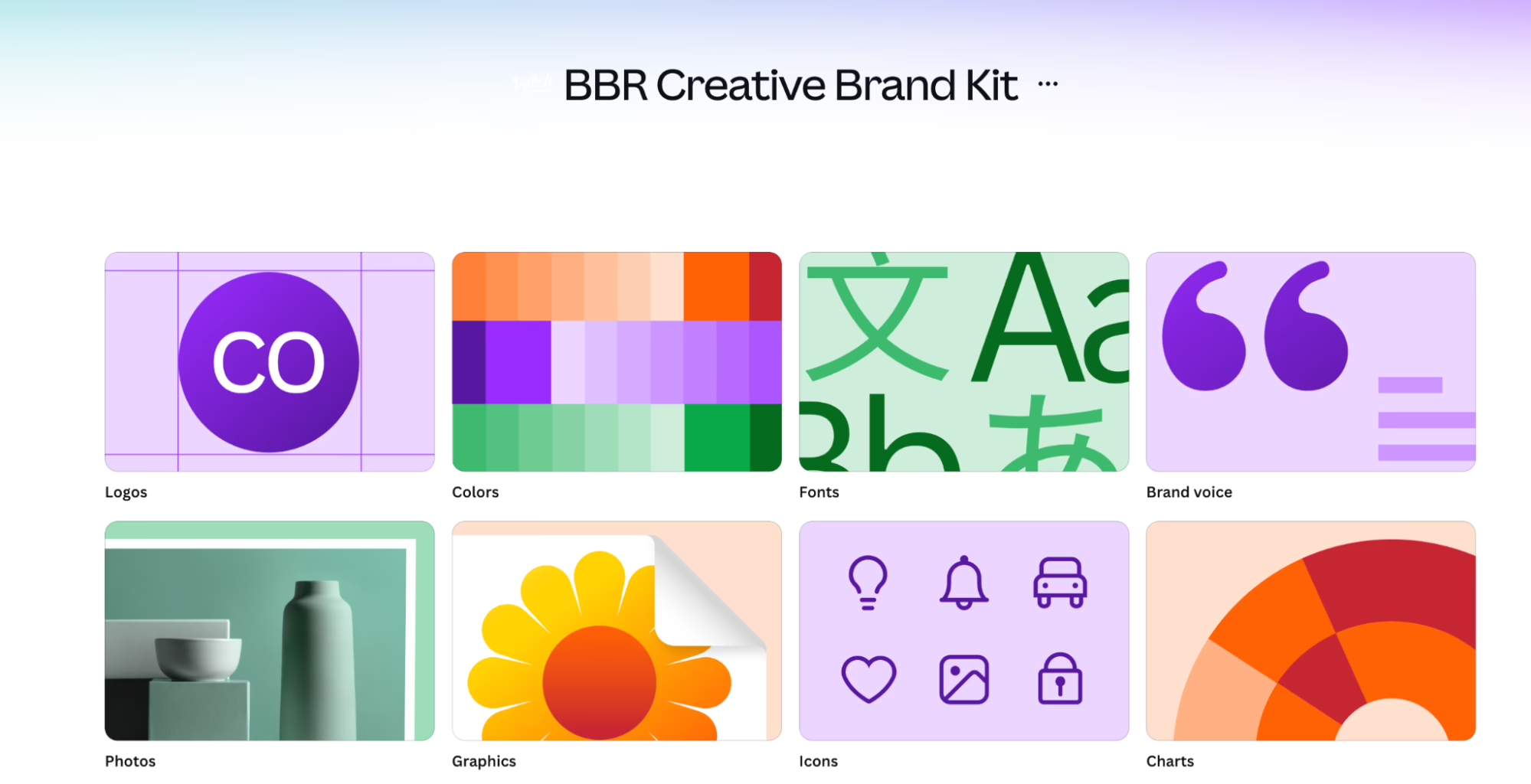
Visual tools are catching up as well. Platforms like Canva include brand kits that store your colors, fonts, logos and other design standards. When AI generates layouts or visual assets within those systems, it can automatically apply those elements, keeping your content visually consistent without you having to correct it every time.
The common thread across all of these tools is simple: the more context you provide, the better the results get. AI isn’t a mind reader. It’s a pattern machine. Feed it your brand’s patterns, and the outputs start to look a lot more like something that belongs to you.
Tips for Writing Better AI Prompts for Marketers
Now that your AI has some understanding of your brand, the next step is telling it what to actually do with that information. Context gives AI direction, but your prompt is what turns that direction into something actually usable. But don’t think every prompt is equally effective. Far from that, actually. The best AI prompts are, of course, context-rich, with explicit instructions and detailed output directions. A useful way to understand why this matters is through something called the “Chinese Room” thought experiment.
Okay, so imagine a person sitting inside a room. Outside the room, people pass written Chinese questions through a slot. The person inside doesn’t understand Chinese, but they have a detailed rulebook that tells them how to respond to the symbols based on their shapes rather than their meanings. By following these instructions step by step, the person produces appropriate written responses in Chinese and passes them back out the slot.
To the outside observer, it appears as though the person understands Chinese and is holding a conversation—but in reality, they are simply executing a set of instructions without any actual comprehension.
The key takeaway is that a system can produce seemingly intelligent, contextually appropriate responses by following instructions and patterns, even without true understanding. AI operates in a similar way. It doesn’t “know” your brand in the human sense—it processes the information and instructions you provide and generates outputs based on patterns it has learned. That’s why vague or incomplete prompts often lead to generic results.
For marketers, this reinforces an important idea: if you want more precise, on-brand outputs, you need to give the system more precise, on-brand instructions.
1. Assign a Role. AI performs better when it knows what perspective to take. Is it responding as your friend? Your financial advisor? Your senior brand strategist? Whatever perspective you’re looking for, your prompt should help tap into that mindset.
2. Provide Brand Context. Explain your company, audience and mission. Who are you? Who are you talking to? What do you want to say? The good news is, if you’ve already configured your personalization settings, some of this context will already be covered.
3. Define the Output Format. Dictate the type of content you want and get specific with it. “Draft a caption for a LinkedIn post with a hook in the first sentence. Break up content with emojis and include a call to action at the end,” is much more effective than just “create a social media post.”
4. Add Constraints. It may sound counterintuitive, but constraints actually force creativity. Character limits, tone guidelines, platform rules—these all help shape the final output into something unique and interesting.
5. Provide Examples. Arguably, the most important step is to show AI what “good” looks like. If you’re prompting for social media captions, for example, provide 1-2 model captions that reflect the tone, style, and format you want to mimic.
So what does this look like in practice? Let’s take a look at the following AI prompt for marketers.
Weak Prompt:

Stronger Prompt:
You are a PR professional and brand copywriter responsible for drafting a press release for a pet food company.
Brand context: This company’s mission is to make healthy pet food affordable for everyday pet owners. It is committed to providing nutritious, high-quality meals while educating pet owners to make informed decisions about their pets’ health. The brand voice is friendly, trustworthy, and approachable—knowledgeable but not overly clinical or corporate. Communication should be clear, straightforward, and free of jargon, hype, or fear-based messaging.
Target audience: Cat and dog owners aged 25–44 in the New England region, as well as media outlets covering pet care, consumer products, and lifestyle trends.
Announcement: The brand is launching a new low-calorie cat food designed to support healthy weight management while maintaining strong nutritional quality, taste, and affordability.
Task: Write a professional press release announcing this product launch.
Structure requirements:
-
- Headline (clear, compelling, not clickbait)
- Subheadline (adds context and value)
- Dateline (City, State — Date)
- Opening paragraph (who, what, when, where, why)
- Body paragraphs (expand on product benefits, brand mission, and market relevance)
- At least one quote from a company spokesperson (e.g., founder, vet partner, or product lead)
- Optional supporting details (product features, ingredient philosophy, affordability angle, availability)
- Boilerplate “About the Company” section
- Media contact section (placeholder is fine)
Key messaging to include:
-
- Healthy pet food should be accessible, not exclusive
- Supports healthy weight management for cats
- Maintains nutritional integrity without premium pricing
- Reinforces the brand’s commitment to education and transparency
Tone and style guidelines:
-
- Professional but approachable (not overly corporate or stiff)
- Clear and concise, avoiding buzzwords and fluff
- Informative and credible, with a consumer-friendly angle
- Avoid exaggerated claims or fear-based messaging
Additional instructions:
-
- Keep the length between 400–600 words
- Write in standard press release format (third person)
- Make it ready for distribution to media outlets without needing edits

As you can see, the same tool offered up completely different responses based on these two prompts. And to be fair, the first one isn’t necessarily wrong—just extremely generic. The difference is that the AI now understands the brand. It’s not guessing anymore—it’s responding to a clear brief. And that’s really what AI prompting for marketing is. At the end of the day, prompting AI isn’t all that different from briefing a creative team. If you give vague directions, you get vague work. If you give clear, thoughtful direction, you get something you can actually build on.
Refine, Refine, Refine
If you take nothing else from this article, at least remember this: the first answer is never the best.
I know, radical idea, right?
But really, just like we brainstorm and iterate as marketers, we need to give AI room to do the same. Here are a few ways to push your AI output further:
1. Increase Originality
Prompt: “Give me five alternative ideas that are bold and unexpected, while still staying true to the brand.”
Why we love it: By specifically asking for unexpected iteration, you move beyond the safe, generic responses and into an uncharted creative flow.
2. Stress-test Assumption
Prompt: “Identify 3 counterarguments to this idea.”
Why we love it: By encouraging critical analysis, we can get our AI marketing tools to pass up surface-level information (AKA the thing that everyone is already saying) and instead prompt deeper thinking.
3. Fact Check
Prompt: “Provide exact references to all statistics and claims made in this draft.”
Why we love it: You should never take data or “facts” provided by AI as true without a clear reference. Remember, generative AI is meant for pattern recognition, like a complicated autocomplete. Just because it adds information that makes sense in the context of the content doesn’t mean it’s true.
4. Align with Brand Voice
Prompt: “Rewrite this to be more [enthusiastic/succinct/authoritative] while still maintaining the same information.”
Why we love it: Guidance on tone and language will ensure the final output is on-brand and consistent.
5. Think Strategically
Prompt: “Suggest three ways this content could support our broader business goals of [XYZ].”
Why we love it: Your content should always align with your overall business strategy. Zooming out allows AI to tweak outputs and ensure the bigger picture is never forgotten.
Own Your Brainpower
AI is impressive, but it’s not a miracle worker. Treating AI like a magic soothsayer and unquestioningly accepting whatever it spits out won’t get your brand the recognition it deserves. It’s fast, yes, and it can churn out content faster than you can open a new Word document. But it can’t replace real human thinking. Instead, when you combine its speed with your expertise and strategic thinking, that’s where the real power comes in.
The Bottom Line
1. Don’t outsource your brain. AI can assist, but leave the strategic thinking to those who know best—your people.
2. Feed it context. Your brand mission, tone and quirks are the secret ingredients that turn “okay” into “exceptional”.
3. Iterate relentlessly. Repeat it with me: I shall never accept a first draft as final.
4. Use it strategically. AI is a tool for acceleration, not a replacement for human expertise.
Remember: using AI thoughtfully doesn’t just save time; it creates AI-driven marketing strategies that stand out and keep your brand human. Everything else? Just more of the same flavorless cake mix.